Citizens for a Livable Cranbrook Society provides grassroots leadership and an inclusive process, with a voice for all community members, to ensure that our community grows and develops in a way that incorporates an environmental ethic, offers a range of housing and transportation choices, encourages a vibrant and cultural life and supports sustainable, meaningful employment and business opportunities.

Monday, August 12, 2013

Advance Notes for the Council Meeting of August 12 6:00pm

Delegations

  1. Quarterly RCMP Report to the Mayor. The report can be read at:https://cranbrook.civicweb.net/Documents/DocumentList.aspx?ID=3277  This report will be presented by Sgt. Lorne Craig.
  2. Priorities for the Cranbrook Archives Museum and Landmark Foundation, Damon Colgen
 Correspondence

9.1       ICBC Road Improvement Program ............through to
9.11            Letter from CAMAL

Proclamations
9.12      Proclamation Breast Feeding
9.12            Proclamation Prostate Awareness

Committee Recommendations

Cranbrook in Motion
That Council approve the following recommendations from the Cranbrook in Motion Committee:
1. That Public Works install a 4-Way Stop traffic control at the intersection of 1st Street South and 9th Avenue South.
2. That Public Works check the timing of the pedestrian crossing signals at the intersection of Victoria Avenue and 2nd Street North and adjust as necessary to ensure adequate time for pedestrians to safely cross.
3. That the City approves the installation of RID911 (Reduce Impaired Drivers) signs within the City; and further, that staff and the RCMP work with MADD Cranbrook Kimberley regarding suitable key locations.
4. That the RCMP be requested to review the issue of vehicle speeds on 2
nd Street South and Baker Mountain Road and report back to the Committee.

Highway 3 Committee
That Council approve the recommendation from the Highway 3/95 Revitalization Committee:
"That Council gives the go ahead to the Ministry of Transportation and Infrastructure (MOTI) regarding the development of the proposed East Entrance pullout with the proviso that the City contributes funds towards information, signage, and landscaping of the proposed location."
ALTERNATIVE:
Do not approve the Committee recommendation, and request a deferral to 2014 from MOTI and include in the City's 2014 Budget discussions.

New Business

12.1 Brick Building
Whereas Council has unanimously passed a motion to demolish the Brick
Building, formerly known as the Works and Electrical Building, behind City Hall.
And Whereas this demolition could be carried out any time.
And Whereas a civic-minded community group has voluntarily come forward
with a plan to secure the building for possible future uses.
And Whereas this group intends to fund-raise and solicit grants from government
and the private sector to carry out its plan, but can't reasonably do this unless the
City guarantees the demolition order will not be acted on for a reasonable length of
time.
And whereas this group has building and construction expertise as well as
promises of donations in-kind and voluntary labour to secure the building.
And whereas an archivist has unearthed many historical facts about the building's
80-year history and its unique architectural features.
And whereas there has been much public comment in favour of saving the
building in the media and through emails to City Hall.
And whereas the Columbia Basin Institute of Regional History and the East
Kootenay Historical Society have both called for the building to be saved.
And whereas a number of possible uses have been suggested for the building if
it's preserved.
THEREFORE BE IT RESOLVED that the City's demolition order be suspended
for one year after passage of this motion to give the community group an
opportunity to secure the Brick Building and redevelop it into a structure that
would serve the City and preserve Cranbrook's brick heritage.
Moved by Councillor Gerry Warner


12.2    Development Variance
To consider approval of an application for a Development Variance Permit for the relaxation of Section 7.09 (3) (c) Regulations of the "Rural Residential (Country) RR-8 Zone" (Cranbrook Rural Zoning Bylaw) to decrease the minimum required front, rear and interior parcel line setbacks for the development of a property located at 3113 - 2nd Street S.

12.3 Referral from RDEK
PURPOSE:
 To consider a referral from the Regional District of East Kootenay (RDEK) for a proposed amendment to the Rockyview Official Community Plan (OCP) and Cranbrook Rural Zoning Bylaws to accommodate an 11 lot residential subdivision with a proposed vacant remainder lot for park use in the Jim Smith Lake Area.
RECOMMENDATION BY: Staff
That Council not recommend approval of proposed Bylaw No. 2486 and Bylaw No. 2487

Bylaws
13.1 Sign Bylaw
 Adoption

13.2
Zoning Amendment for
In an attached cover letter, the applicant indicates that the proposed amendment is in support of a new, mobile recreational vehicle (RV) repair service, which satisfies a growing need for mobile RV repairs. While primarily a mobile business, the existing building and repair bay on the property would also serve as a location for RV repairs and the storage of parts. The applicant indicates the location is convenient to the growing RV travel along the highway.


Sunday, August 11, 2013

An Unusual Sighting

While kayaking, Bob and Gretchen Whetham were lucky recently to spot this unusual white loon on Columbia Lake.

A white phase Loon photo courtesy Bob Whetham

Saturday, August 10, 2013

Columbia Basin Culture Tour Today in the Cranbrook Gallery 10:00am - 5:00pm

The Columbia Basin Culture Tour Weekend has officially started! President Mitchell Pocha kicked off the interactive PROTODOE exhibit this morning as you can see from the photograph attached. You are invited to bring friends and family down and you too can contribute to PROTODOE to make her fancy for the August 24th Art in the Park event. Gallery open 10-5pm, Saturday and Sunday this weekend only! Free nibbles and drinks whilst they last. Mitchell is also working on this own sculpture in the gallery space today so come and witness him at work.
135 Tenth Av S.


Why do so many Dutch people cycle?

cyclists in Amsterdam photo Jenny Humphrey
Help
There are more bicycles than residents in The Netherlands. In cities like Amsterdam and The Hague up to 70% of all journeys are made by bike.
This is because of a vast network of cycle paths that are clearly marked, with smooth surfaces, separate signs and lights, and wide enough to allow side-by-side cycling and overtaking.
So with rising levels of obesity, high fuel prices and increasing congestion, what is stopping the UK from going Dutch?
Reporting for BBC Newsnight Anna Holligan travelled from The Hague to Westminster on her trusty "omafiets" ("granny bike") to find out.

Friday, August 9, 2013

Michael's Musings

Political, economic and social challenges posed by decline of rural areas
By Michael J Morris
As I travelled from British Columbia to Ontario and back in the summer of 2012, there was one constant refrain that stayed with me all the way, and remains with me now. I was witnessing first hand the decline of rural Canada, and quite possibly, if things don't change soon, Cranbrook may meet the same fate as I saw in other parts of the country -- boarded up hotels, service stations, stores, restaurants, and homes, in communities that may never have been really prosperous but held their own not so many years ago.
Transient that I have been, although this week marks 24 years that I have lived in Cranbrook, I am one of those fortunate Canadians who lived in Alberta. Saskatchewan, Manitoba and Ontario before coming to British Columbia in 1989.
On my most recent trip to Ontario, I travelled by bus from Cranbrook to Calgary, flew to Ottawa, and then drove to North Bay, on to Sudbury and further across Highway 17 to Highway 129 and north for a high school reunion in my home town of Chapleau. I've made the Ontario portion of my trip many times, and that is when it struck me that things weren't the same, Some communities had all but disappeared except for the closed buildings. I flew back from Ottawa to Calgary.
Perhaps a sign of the times was that the busiest business anywhere on my trip was a Tim Hortons located just off the highway at Blind River, Ontario. 
While I noticed it most in Ontario, on the bus trips to and from Calgary, I saw the same situation developing in some communities in Alberta and British Columbia. Friends have  told me it's the same in Saskatchewan and Manitoba. I have to make a trip to Brandon, Manitoba, and if I can find a Greyhound bus that will get me from here to there and back, I will see for myself.
There has been some discussion recently about empty space in downtown Cranbrook, and as I continue my walking tours, I am noticing the same along 'The Strip' and at Tamarack Centre.
In those parts of rural Canada that have been especially hard hit, there has been a significant population decline, but so far statistically that does not seem to have become a significant factor in Cranbrook, although in the 24 years I have been here, there has been a net population increase of about 15 to 20 percent. Not exactly inspiring considering that it was just over 16,000 in 1989.
Cranbrook may remain static for some time yet given its role as a regional service centre but if the outlying communities experience population decline, that will obviously affect this community adversely.
Writing in Dal News, a publication of Dalhousie University in Halifax in June 2012, Ryan McNutt notes that "the 'best of times' story is that Canada’s urban centres are strengthening in population, boosted in no small part by significant immigration numbers in major cities like Toronto and Vancouver. The 'worst of times' story ...  declines in rural areas, posing significant political, economic and social challenges for Canada’s future."
McNutt quotes Fazley Siddiq, economics professor at Dalhousie’s School of Public Administration and a fellow at the John F. Kennedy School of Government at Harvard University as saying,  “It’s a real tragedy, because the metropolitan/non-metropolitan balance that we’ve had has been altered in a way that’s not desirable,” 
“It’s one thing to say that we’re becoming more and more urbanized, a modern industrialized country. Those developments sound positive, and they are in many respects. But behind the mask of that success is a hollowing out of much of the rest of Canada. And if it isn’t happening yet in certain parts of the country, the potential for this trend to get a lot worse is there.”
Dr. Siddiq noted that while urban growth is not without its challenges—congestion, pollution, traffic and infrastructure, housing and schooling—the increase in population brings with it more business activity and a larger tax base, which can support solutions for addressing those challenges. And then there are the positives of urbanization: more career opportunities, a younger dynamic population, housing booms and more."
Let me just add I believe that Cranbrook can avoid many pitfalls associated with urban growth mentioned by Dr. Siddiq with proper planning, and the creation of a conceptual framework that ensures a livable community in all its manifestations. That will take some compromising I know.
“A declining population, in contrast, I don’t see too many positives associated with it,” says Dr. Siddiq. “It can be quite traumatic for families and businesses when home prices go down, jobs become increasingly scarce and businesses no longer are sustainable in small communities. So then people leave, leading to another reduction in business activity and home prices. It’s a downward spiraling effect.”
Dr. Siddiq is studying population trends and their effect but in the McNutt article he did not sound overly optimistic: “Our history has been one of an expanding frontier, and economic activity spilling over. That’s why we have the country that we do. But whether we will continue to be able to sustain viable communities, viable populations, in far-flung areas, is something that causes me great concern.”
However, on a more optimistic note the Canadian Rural Research Network in its June 2013 report found that some rural areas are experiencing population growth - the one closest to Cranbrook that is included in top five rural regions in employment growth in Cranbrook  is Camrose-Drumheller Economic Region in Alberta.  Showing employment growth above the national average for 12 consecutive months are  Thompson-Okanagan Economic Region and Cariboo Economic Region in British Columbia.
These regions may be places to start looking at how they are doing it, and they are not too far away.
The task of ensuring a viable future for Cranbrook, may not be easy, given the immense divide that seems to prevail within the community, but as Lyndon Johnson, former president of the United  States used to say when he was Senate Majority Leader, quoting from the prophet Isaiah, "Come, let us reason together." Much progress can be made when the focus is on those things that bring us together rather than those that divide us.

My email is mj.morris@live.ca

Full disclosure: I am not now and never have been a member of the Citizens for a Livable Cranbrook Society; however, I did conduct a workshop for its members for which I was paid.


Thursday, August 8, 2013

What's Happening...........

Ongoing

Urban Artsy Deer
Just very few left for you to decorate
available at the Cranbrook and District Arts Council,
135, 10th Av S
Judging and prizes August 24th , Rotary Park

Saturday August 10th

Cranbrook Farmer's Market
adjacent to Rotary Park
9:00am - 1:00pm


Columbia Basin Culture Tour 
        
Tessa McGregor preparing for the Columbia Basin Culture Tour
 by hanging the work of Paula Cravens

10:00am - 5:00pm
Cranbrook Gallery
135, Tenth Av S.
Come, visit, help us decorate our protodoe (artsy deer)
(Children most welcome)
and view the work of local artists:

Paula Cravens, Lorna Damstrom, Grace Ivers, Steen Jorgensen, Jazmin Knihnicki, 
Jim Robertson, Colleen Routley,
Walter Schmidt, Marg Skoberg, and Ronda Wood                                 

Sunflowers by Jazmin Knihnicki, 


Sunday August 11th

Columbia Basin Culture Tour
10:00am - 5:00pm
Cranbrook Gallery
135, Tenth Av S.
Come, visit help us decorate our protodoe (Children most welcome)
and view the work of local artists:  PaulaCravens, Lorna Damstrom, Grace Ivers, Steen Jorgensen, Jazmin Knihnicki, 
Jim Robertson, Colleen Routley, Walter Schmidt, Marg Skoberg, and Ronda Wood     

Wednesday August 14th

Edible Garden Tour
5:00 - 9:00pm
The map is in the works, available August 9th at Top Crop, Top Crop Too, Wildsight, 
http://www.wildsight.ca/edible-garden-tour


Requiem for A Glacier

by Dave Quinn, photos Dave Quinn

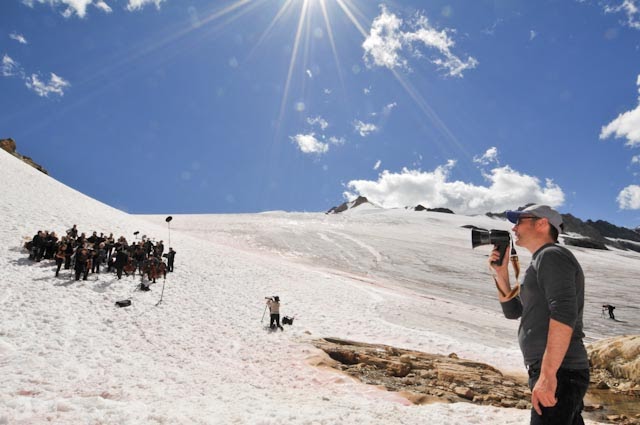
Local volunteer porters cart in the mountains of instruments,
 sound gear, and other equipment required for the project.
On July 27th, fifty Kootenay musicians, aged 12 to 83, along with fifty porters, support staff, sound techs, camera techs, and directors, performed Requiem for A Glacier, a four-part Requiem composed by Victoria, BC composer Paul Walde, on the West Farnham Glacier in the Purcell Mountains West of Radium.

The piece was composed to bring awareness to melting glaciers, and particularly to these specific glaciers, on which a recent approval could see a 6500-person ski resort built.

 The proposed Jumbo Glacier Resort has been one of BC's most controversial proposals for nearly 25 years, and the Requiem is a latin translation of a government press release announcing the approval of the controversial project, as well as detailing 25 years of public opposition.
   
Victoria Composer Paul Walde directs set up on the East Farnham Glacier
The Jumbo area has been documented by BC biologists as being a critical linkage are for the region's threatened grizzly population, and the region is already home to 19 ski resorts within a five hour drive, all of which are in existing communities, and many of which are struggling with declining skier visits, overbuilt real estate, and increasing costs. This proposed resort is 55km up a forestry road, in an area known as the "Heart of the Purcells", which is rich with mountaineering history and wilderness-type recreation opportunities. These are some of the main reasons that between 75 and 95% of poll respondents and public input for the approval process have been against the resort, for more than 20 years.

Conductor Ajtony Csaba, director of the University of Victoria Symphony and the Central European Chamber Orchestra, led the performance, which took place at the base of the Commander Glacier, and on the receding toe of the East Farnham Glacier. A documentary film and an art installation are planned.

Composer Ajtony Csaba leads musicians through the opening piece of Requiem for a Glacier, with the rapidly receding toe of the Commander Glacier in the background, some of the proposed 'summer skiing' for the Proposed Jumbo Glacier Resort (a lift is proposed for access up this heavily crevassed and rapidly melting glacier).

Wednesday, August 7, 2013

The Edible Garden Tour is back this year

From Wildsight

Edible Garden Tour: Aug 13 and 14 

in Kimberley and Cranbrook


Join us next week for a chance to check out some of Kimberley and Cranbrook's abundant edible gardens! 

Whether you're a seasoned greenthumb or just starting out, there is inspiration aplenty.  It's also a great opportunity to connect with other veggie gardeners in the community.  


Maps will be available to pick up for free at Top Crop, Top Crop Too, Kimberley and here beginning on August 9.  

The tour will be in Kimberley on Tuesday, August 13 from 5-9pm and in Cranbrook on Wednesday, August 14 from 5-9pm.  

Entrance to gardens is by donation.  Children are welcome, but please leave your pets at home.

For more information or to add your garden to the tour, please call (250)427-2535 ext 223.
Wildsight - Kimberley / Cranbrook Branch
2 - 495 Wallinger Avenue, Kimberley, BC V1A 1Z6
Phone: (250) 427-2535 | kimcran@wildsight.ca

Monday, August 5, 2013

Container Housing

From the Tyee:
http://thetyee.ca/Blogs/TheHook/2013/08/02/ContainerSocialHousing/

Lots of images are available by simple doing a search on Shipping Container housing.

Shipping container social housing makes debut in VancouverBy Colleen Kimmet
Published August 2, 2013 11:37 am |  


Back in 2010, former Tyee reporter Monte Paulsen proposed an unconventional solution to Vancouver's housing problem: use recycled shipping containers to build green, low-cost homes in the city.
In his three-part series, Paulsen found that these big steel boxes are essentially the ideal building blocks, "not only far more environmentally friendly but also significantly less expensive than the heavy concrete construction that has reshaped the city's skyline."
His articles highlighted several innovative projects in London, Amsterdam and even Victoria.
Three years later, shipping container housing has come to Vancouver.
Yesterday, Atira Women's Resource Society, unveiled a 12-unit, three-level social housing project made of 12 recycled shipping containers. It's the first development of its kind in Canada. Each self-contained unit ranges from 280 to 290 square feet. The first occupants are expected to move in next month.


http://www.theprovince.com/news/Recycled+shipping+containers+called+home+downtown+Vancouver/8739364/story.html
-