If you are planning on changing your toilet to a low flow model then the City of Cranbrooks $50 rebate will provide extra incentive. The change to low flow toilets offer significant water savings. There is a lifetime maximum of two $50 rebates per household. Each application is evaluated and processed on a first come, first serve basis. There will only be 200 rebates available and the program has proved to be very popular.
Old toilets can be dropped off at the Cranbrook Transfer Station at no charge and need to have their disposal verification forms signed. Go here to the City of Cranbrook website to download the form http://www.cranbrook.ca/ The low flow toilet rebate is part of the City of Cranbrooks efforts to increase water use awareness in our community.
Tuesday, May 3, 2011


Saturday, April 30, 2011
The Tree of Life

Friday, April 29, 2011
Cranbrook's Armond Theatre

Thursday, April 28, 2011
Release a Fish, Save a Species

Wednesday, April 27, 2011
East Kootenay Invasive Plant Council 3rd Annual AGM & Conference - April 7, 2011
While you might think that this post is old news, indeed, it is very timely. Garden clean up has started and people are thinking about what plants they might want to purchase for their gardens this year.
Did you know that some of the plants that we purchase to put in our gardens are invasive, and have choked out native species. The RDEK offices in Cranbrook has some valuable literature you can pick up to ensure you are planting species that are not invasive. Some of the invasive plants are: Butterfly Bush, Common Periwinkle, English Holly, English Ivy, Giant Hogweed (nasty!), Himalayan Blackberry, Knotweeds (Japanese, Giant and Bohemian), Himalayan balsam (Policeman’s Helmet), Purple loosestrife, Scotch Broom, Spurge Laurel/Daphne, Yellow Flag Iris, Dalmation toadflax, Oxeye daisy, and Yellow Archangel/Lamium. People generally want to avoid planting ornamental and food species that can spread out of control to other gardens and surrounding grasslands, forests and parks.
In 2010 the EKIPC spent roughly $321,400.00 on targeted on-the-ground treatments, which is more money spent than in any previous year, plus additional work done by three crews hired by the Invasive Plant Council of BC through the Hot Spots program.
The speakers were:
- Michael Keefer (expert in plant science, plant ecology, native plant horticulture, ecological restoration, and ethnobotany) is adjunct Professor at the Centre for Livelihoods and Ecology at Royal Roads University, and President of both Tipi Mountain Native Plants Ltd. and Keefer Ecological Services Ltd. He talked about partnership building and Ecosystem Restoration.
- Dr. Matthias Herborg (Aquatic Invasive Species Coordinator for BC’s Ministry of Environment) is focusing on applying his academic background to applied management problems of aquatic invasive species.
- Katie Villano Spellman (plant ecologist at the Institute of Arctic Biology at the University of Alaska Fairbanks) fuses her experiences as an educator and ecologist and wrote Alaska’s first invasive plants curriculum for elementary schools and conducts teacher training throughout the state. Her current research focus is insect-invasive plant relationships at northern invasion fronts in Alaska.
- Mollie McCahon (Lakeshore Assessment System Coordinator in Sandpoint, Idaho, for Bonner County) spoke on aquatic invasives, and brought home the importance of transboundary border inspections giving some frightening examples of how unclean boaters, unchecked at the border, are transporting Didymos (an invasive known as rock snot), and zebra and Quagga mussels.
- Tim Ross (professional agrologist who came to the East Kootenays on a three-year contract 20 years ago and operates Ross Range and Reclamation Services) gave the Wigwam Flats Report. He shared some research findings from an ongoing noxious weed control and monitoring project.
The new EKIPC Board has some challenges ahead and are considering expanding the invasive plants by adding aquatics. The workshop portion was full of very worthy ideas for dealing with the spread of invasives. Best wishes to the new Board!
Remember – “Weeds are a Pain in the Grass”
Tuesday, April 26, 2011
Keeping up with Change
Another theme of Dr. Greg Halseth's lecture this last month was 'change'. Never before has change happened so quickly. Keeping up and being prepared is one key to the global and local survival of an economy.
Monday, April 25, 2011
Safe Lawns
A very informative and inspirational talk and movie showing was given to a small but enthusiastic group of people on Thursday, April 21st on the subject of safe lawns. Much of Paul Tukey's information can be found on his blog and website at:
http://www.safelawns.org/
With our local School Board having just decided to ban the use of cosmetic pesticides on its' fields and more information appearing regularly on the dangers of pesticides this talk was well timed.
SafeLawns.org is just one of the many sites which provide good ideas for lawn maintenance. There are additional alternatives such as clover lawns which might be considered when deciding to avoid those suspect pesticides. Just accepting an 'imperfect' lawn also goes a long way too. A grassed area even when it contains plants other than grass can be perfect for playing soccer or back yard games or for complimenting a beautifil shrub and flower border.

 |
| TM Roberts students start the evening with an Earth Day Song |
http://www.safelawns.org/
With our local School Board having just decided to ban the use of cosmetic pesticides on its' fields and more information appearing regularly on the dangers of pesticides this talk was well timed.
 |
| Patti Moore introduces Paul Tukey |
 |
| Paul Tukey |

Sunday, April 24, 2011


Saturday, April 23, 2011
Planet Care All Year

One new habit for my household this year has been curbside recycling and although I have always thought I did a pretty good job of sorting and collecting my recyclables, having this service has made a huge difference to how I think about every box, piece of plastic, tin and glass container. It is so much easier now to put them all in the blue bin. They are removed from my curbside every week and sorted for me. So between my home compost and my recycling service, my one garbage can now only gets put out less than once a month. Cranbrook has a choice of curbside recycling businesses and my year’s service fee was a gift last Christmas from my children – it was a great gift and I truly appreciate it every week.
Members of Rocky Mountain Naturalists, Streamkeepers and Citizens for a Livable Cranbrook were out cleaning up Joseph Creek this past week.


Friday, April 22, 2011
Dunrobin Repatriated
It was a sad day on Friday, April 16th when the closeted Dunrobin saw light of day for the first time in several years and was loaded onto a flatbed for the first leg of its journey back to the UK. The engine and coach once the 'toy' of the Duke of Sutherland were a much loved feature of the Fort Steele railway for many years. 1077 took over the main duties many years ago and the old train set was left in the shed hoping for repair. Unfortunately parts and cost issues made this impossible and so it was decided to sell the engine and coach back to their homeland. After restoration in the Severn Valley, the Dunrobin and coach will be operated and displayed in the Beamish Museum.
The Dunrobin was a 'colourful 'addition to Fort Steele although its' history was not linked at all other than the engine provided the needed service of pulling the carriages. When the history of the Dunrobin and its' original owner was relayed to the many guests who rode the train during its stay at Fort Steele, it was not uncommon for the conductor to be asked "When will we see the Duke's castle, or "Will we meet the Duke?"
After the decision was made to sell the Dunrobin, it was due to Bob Whetham's hard work that this valued part of rail history, a dear little train with its one unused carriage, was secured the appropriate and safe home to which it will go. It is already displayed on the Beamish Museum website.
http://www.beamish.org.uk/beamish-buys-dunrobin/
For more information:
http://fortsteeleheritagetown.blogspot.com/2011/01/dunrobin-to-return-home.html

The Dunrobin was a 'colourful 'addition to Fort Steele although its' history was not linked at all other than the engine provided the needed service of pulling the carriages. When the history of the Dunrobin and its' original owner was relayed to the many guests who rode the train during its stay at Fort Steele, it was not uncommon for the conductor to be asked "When will we see the Duke's castle, or "Will we meet the Duke?"
After the decision was made to sell the Dunrobin, it was due to Bob Whetham's hard work that this valued part of rail history, a dear little train with its one unused carriage, was secured the appropriate and safe home to which it will go. It is already displayed on the Beamish Museum website.
http://www.beamish.org.uk/beamish-buys-dunrobin/
For more information:
http://fortsteeleheritagetown.blogspot.com/2011/01/dunrobin-to-return-home.html

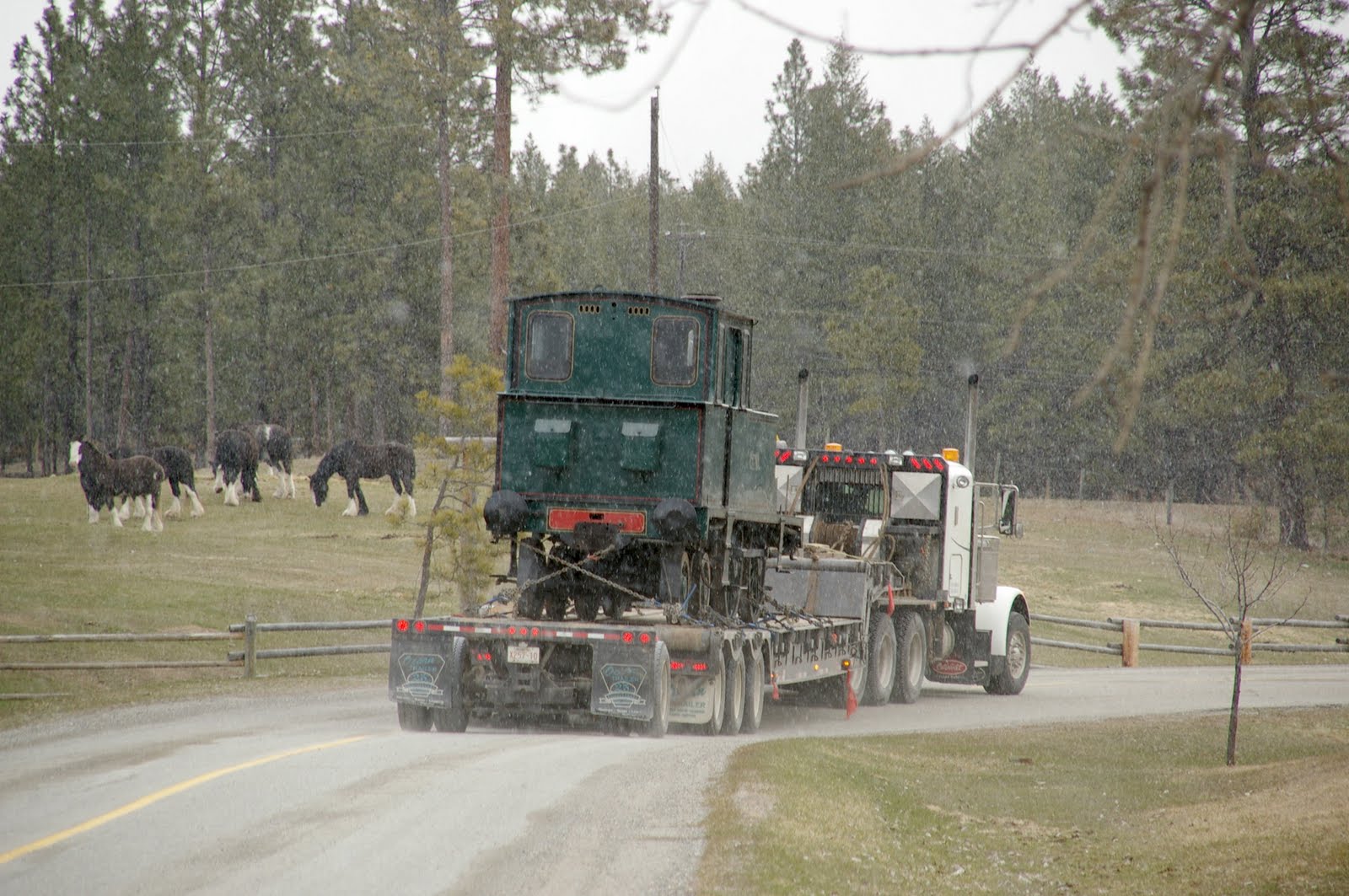 |
| Fond farewell |
 |
| The beautiful coach and upholstery well-protected from the elements Thanks to Bob Whetham for the photos. |
Subscribe to:
Posts (Atom)